The AUUD Matrix
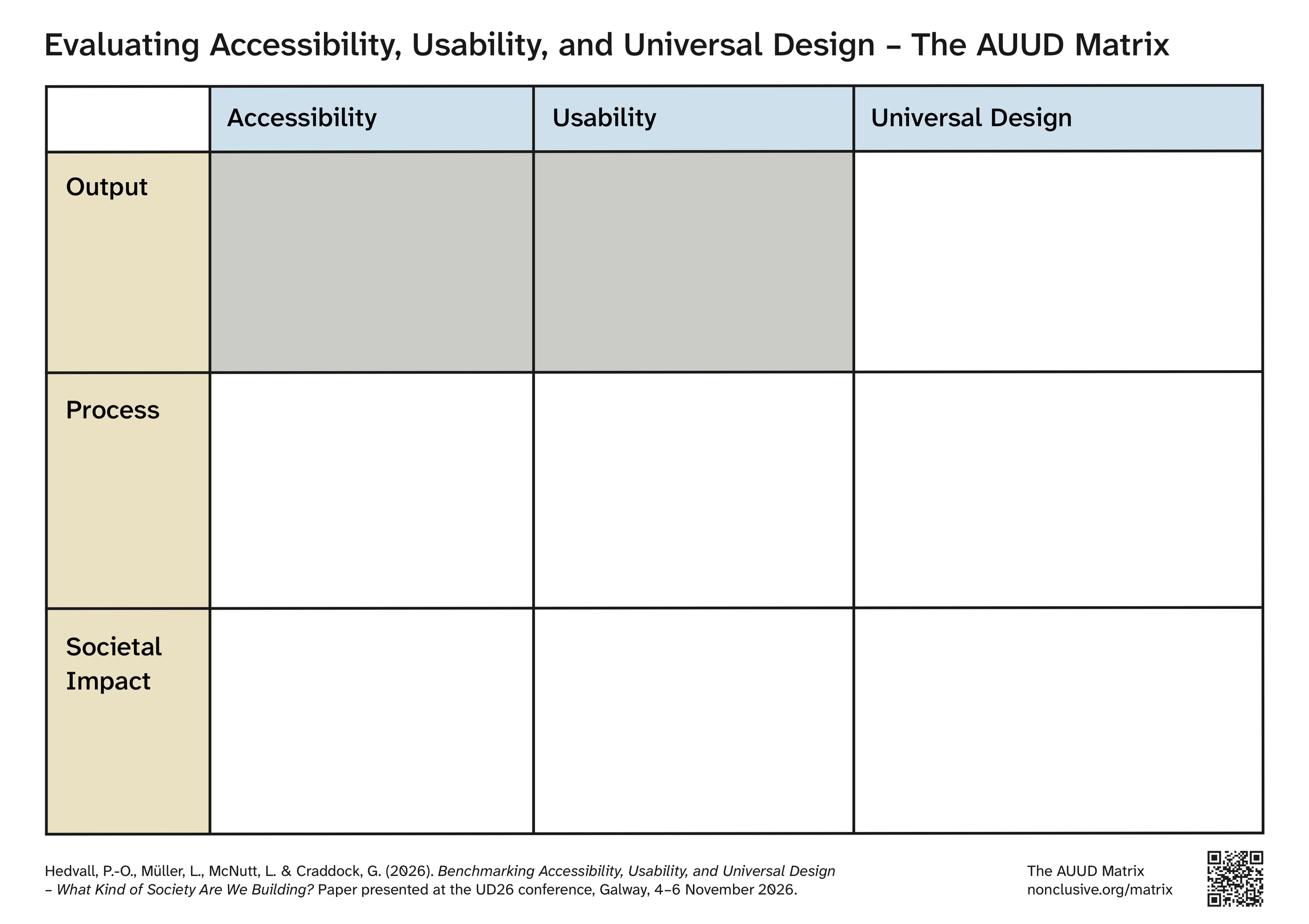
A 3×3 matrix for evaluating Accessibility, Usability, and Universal Design: what is evaluated, and at which level.
What it is
The matrix is a thinking tool, not a compliance checklist. I first presented it in newsletter edition 15, where I also asked readers what they would put in the cells. The columns say what is being evaluated: Accessibility, Usability, and Universal Design. The rows say at which level: Output, Process, and Societal Impact.
Most evaluation of Universal Design today happens in the output row. Does the building meet the building regulations, does the website meet WCAG? That is mainly accessibility and usability evaluation. The two shaded cells are well charted. Many of the open questions are in the seven other cells, and the lower right corner, Universal Design at the societal level, is the one I find most interesting.
The matrix rests on the argument in the paper with Ståhl and Iwarsson that accessibility, usability, and Universal Design are distinct and complementary, and that all three need to be evaluated. For the societal-impact row I take inspiration from the Positive Peace framework, which measures peace through the conditions that make peace possible rather than by the absence of war alone. None of those conditions is peace, and I think the same logic applies to Universal Design.
The matrix is presented in a paper at UD26, the 8th International Universal Design Conference, in Galway in November 2026. At the same conference, Lilian Müller, Larry McNutt, Gerald Craddock and I run a workshop where the participants fill the cells with questions, thoughts, and candidate indicators. The reasoning behind the matrix is on the key ideas page.
Print the matrix, put it on a table, and fill it in. The cells are empty on purpose.
Download
The PDF is the print master: A1 landscape, vector, fonts embedded, so it scales to any poster size. The Word file is the preliminary evaluation form from newsletter edition 15. The paper is the accepted manuscript; the IOS Press version replaces it when the proceedings appear.
The dataset
The pilot tests and the UD26 workshop produce material for the matrix: the questions, thoughts, and candidate indicators the participants put in the cells. I will publish that material here as an open dataset after the conference, under the same CC BY 4.0 license. This page is its permanent address.
How to cite
- Hedvall, P.-O., Müller, L., McNutt, L., & Craddock, G. (2026). Benchmarking Accessibility, Usability, and Universal Design – What Kind of Society Are We Building? Paper presented at UD26, the 8th International Universal Design Conference, Galway, 4–6 November 2026.
- The figure: Per-Olof Hedvall (2026). The AUUD Matrix. nonclusive.org/matrix. CC BY 4.0.
Stable address: nonclusive.org/matrix. It keeps pointing here, so it is safe to print and to put in a QR code.
References
- Hedvall, P.-O., Ståhl, A., & Iwarsson, S. (2025). Accessibility, usability and universal design – still confusing? Harmonisation of key concepts describing person-environment interaction to create conditions for participation. Disability and Rehabilitation, 47(25), 6750–6759. https://doi.org/10.1080/09638288.2025.2491831
- Institute for Economics & Peace (2024). Positive Peace Report 2024: Analysing the factors that build, predict and sustain peace. Sydney: Institute for Economics & Peace.
- Hedvall, P.-O. (2026). Benchmarking Universal Design – Are We Looking in the Right Place? Nonclusive by Design, edition 15. https://nonclusive.org/posts/n15-benchmarking-universal-design
License: Open Educational Resource
Everything I have created here is shared under the Creative Commons Attribution 4.0 International license (CC BY 4.0).
You may:
- Share: copy and redistribute the material in any medium or format.
- Adapt: remix, transform, and build upon the material.
Under the following condition:
Attribution: give appropriate credit and indicate if changes were made. A simple "Per-Olof Hedvall, nonclusive.org" is enough.
This applies only to content I have created. Any third-party content, such as quoted images, may be under a different license and is marked accordingly.